Does a space heater use a lot of electricity?
Yes. A space heater is the single hungriest thing most people ever plug into a regular wall outlet. On its high setting, a standard 1500-watt heater draws 1.5 kilowatt-hours each hour, about 28 cents at the average US electricity rate, and left running around the clock it burns through more electricity in a month than the average American home uses in total. None of that makes it the wrong tool; it makes it a tool worth doing the math on. This guide lays out the actual numbers per hour, per day, and per month, what shows up on your bill, why no brand of heater beats the physics, and the handful of habits that decide whether yours costs 30 dollars a month or 200.
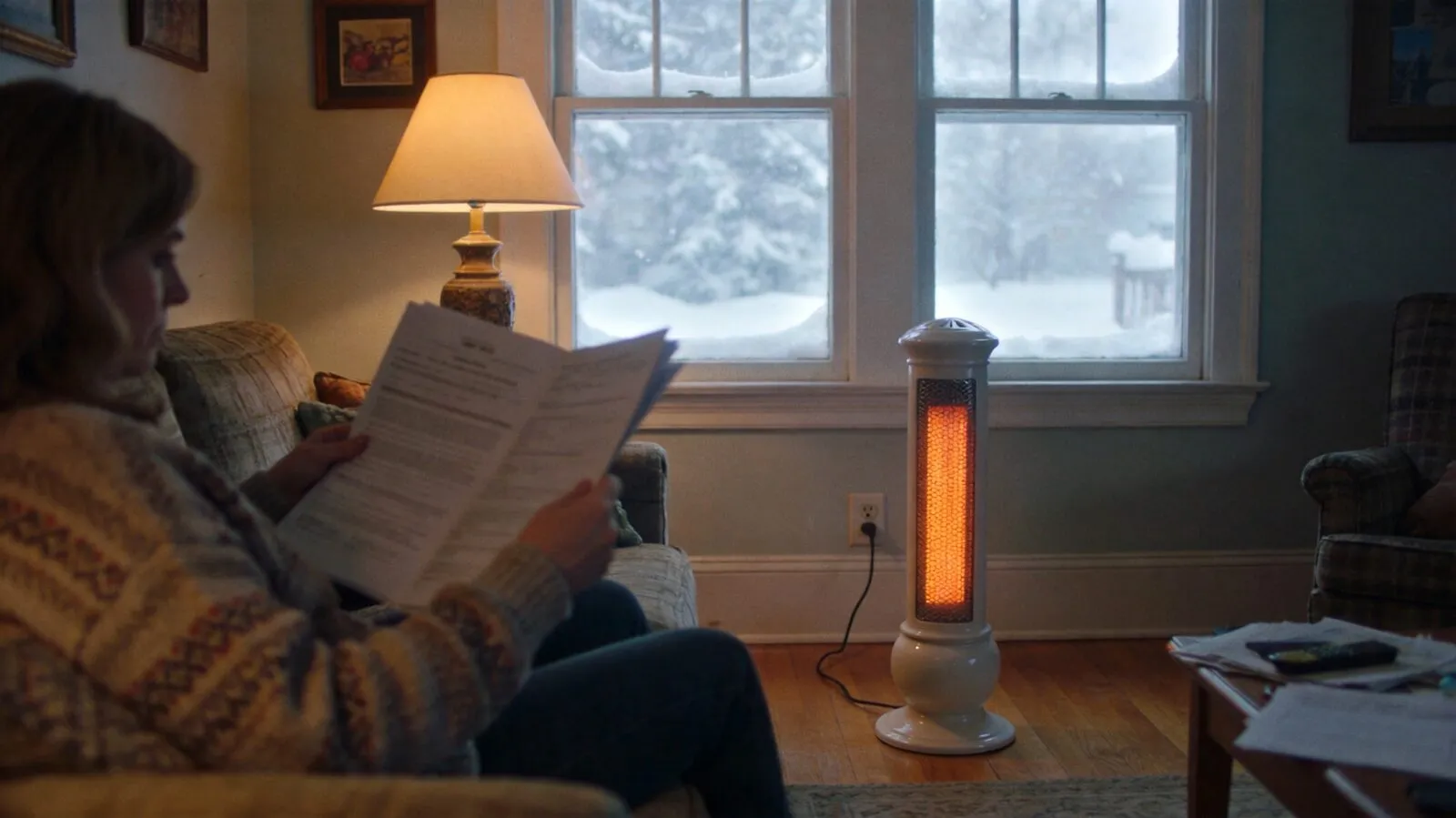
How many watts does a space heater use?
Nearly every portable heater sold in the US runs on 750 watts on low and 1500 watts on high, with small desk units in the 200 to 500 watt range. The 1500-watt ceiling is not a coincidence: a standard 120-volt household circuit is rated for 15 amps, and a 1500-watt heater pulls 12.5 of them. That is essentially the whole circuit. It is why heaters do not come any bigger, why the breaker trips when anything else runs on the same circuit, and why the plug should always go straight into the wall, never into an extension cord or power strip that was not built for a continuous 12.5-amp load.
Watts are also the whole story on heat output. Every watt becomes heat, so 1500 watts produces the same warmth whether the heater cost 25 dollars or 500. When you see a heater advertised as efficient, check the wattage; that number, times your hours and your electricity rate, is the bill.
How much does it cost to run a space heater per hour, day, and month?
The arithmetic is one line: kilowatts times hours times your rate. On high, a space heater uses 1.5 kWh per hour, which at a national average rate near 18 cents comes to roughly 28 cents an hour. On the 750-watt low setting, half that. From there, the hours you run it do all the damage.
1500 watts on high
Monthly cost by hours per day and electricity rate
| Hours per day | kWh per month | At 18¢ (US avg) | At 12¢ (cheap) | At 30¢ (high) |
|---|---|---|---|---|
| 2 (taking the chill off) | 90 | ~$16 | ~$11 | ~$27 |
| 4 (evenings) | 180 | ~$33 | ~$22 | ~$54 |
| 8 (workday office) | 360 | ~$66 | ~$44 | ~$108 |
| 12 (most of the day) | 540 | ~$100 | ~$65 | ~$162 |
| 24 (around the clock) | 1,080 | ~$199 | ~$130 | ~$324 |
Those are worst-case numbers, and the difference between worst case and reality is the thermostat. Once a small, closed room reaches the set temperature, the element cycles off and may run only 20 minutes out of each hour, so metered consumption in a decent room commonly lands 30 to 50 percent below the nameplate math. There is no cycling discount in a drafty garage, an uninsulated sunroom, or on a heater with the dial cranked past what the room can reach; in those cases the element never rests and the full-draw column is your bill. A plug-in watt meter costs about 25 dollars and settles the question for your exact room in a day.
How much will a space heater raise my electric bill?
The average US home buys about 900 kWh of electricity a month, roughly a 166-dollar bill. One heater on high for 8 hours a day adds 360 kWh, about 40 percent of an entire average home's usage, on top of everything else. With realistic thermostat cycling that lands around 33 to 46 dollars a month added; a few evening hours adds 15 to 30 dollars. That is the well-behaved range.
The bill-shock cases follow a pattern, and they are all versions of the same mistake: treating a heater as background heat instead of spot heat. A heater carrying an unheated basement office all day runs at near full draw and adds about 100 dollars a month by itself. A heater in every bedroom overnight adds 200 dollars a month while the furnace bill barely moves, a net loss. And a single heater left running around the clock uses 1,080 kWh a month, which is more electricity than the average home's entire meter reading. If a heater is standing in for broken central heat in a rental, document the usage; heat is a required service in most places with a heating code, and a plug-in heater is not a substitute for it.
For scale against the rest of the house: 8 hours of heater is 6 to 7 times what your refrigerator uses all day, and 10 to 30 times the draw of the TV in front of it. If your winter bill jumped and you are not sure the heater is the reason, our winter electric bill guide works through the other suspects.
Is any space heater cheaper to run than another?
No. Ceramic, infrared, oil-filled, mica, and the 400-dollar cabinets sold on late-night TV all convert electricity to heat at 100 percent, so at the same wattage they cost exactly the same per hour. The miracle-heater pitch has been tested to death with plug-in meters, and the result never changes: a 1500-watt unit draws 1500 watts, whatever the cabinet looks like. The oil-filled radiator's reputation for cheap running has a kernel of truth, but the credit belongs to its steady thermostat cycling and thermal mass, not the oil; watt for watt it costs the same. Eco modes save real money only compared to a knob-only heater blasting away with no thermostat at all.
What price does buy is a thermostat that cycles tighter, a quieter fan, and safety hardware, which is exactly how to shop instead. Our ranking of the best space heaters picks by room and build quality, since running cost is off the table.
Is it cheaper to run a space heater or central heat?
Per unit of heat delivered, plug-in electric heat is the most expensive common way to warm a house. At average prices, resistance electricity costs about 5.30 dollars per 100,000 BTU, versus roughly 1.50 for a high-efficiency gas furnace or a heat pump and about 1.80 for an older 80 percent furnace. Gas and heat pumps deliver the same warmth at roughly a third of the cost.
So the heater wins only as a spot tool, and the clearest cases sort by what your central heat runs on:
- Central heat is electric baseboard or an electric furnace: the heater is an unambiguous win. Both are resistance heat at the same price per BTU, so warming one closed room with 1500 watts instead of the whole house with 10,000-plus genuinely saves money.
- Central heat is a gas furnace: the margin is thin. Setting the house back 8 to 10 degrees saves perhaps 10 to 15 dollars a month in gas, while an evening heater costs around 30. It only pencils out when the heater displaces a lot of furnace runtime, such as one occupied room in a mild shoulder season.
- Central heat is a heat pump: nudge the heat pump instead; it makes the same heat on a third of the electricity. The exception is deep cold or a big setpoint jump that lights up the auxiliary strip heat, which is 5,000 to 15,000 watts of resistance. When the aux indicator is on anyway, a 1500-watt heater warming the one cold room is the smaller load.
Running several heaters at once fails the math on every fuel: three of them for a full workday each adds roughly 190 dollars to a monthly bill, triple what the same heat costs from gas or a heat pump.
How do I make a space heater cost less to run?
The heater's brand does not move the bill; these habits do, in rough order of impact.
- Use the thermostat and set it low. Duty cycle, not wattage, decides the monthly cost. A heater cycling to hold 66 degrees in a closed room uses a fraction of one pinned on high, and every degree lower helps.
- Shrink the space. Close the door, block the draft under it, pull the curtains. The smaller and tighter the room, the sooner the element rests.
- Put it on a schedule. A built-in timer or a smart plug that kills it when you leave the room, or an hour after you fall asleep, quietly deletes the most expensive hours.
- Warm the person, not the room, overnight. A heated mattress pad or electric blanket draws 60 to 200 watts, a tenth of a space heater, and costs pennies a night. For sleeping, it replaces the heater outright.
- Set back the heat you are replacing. The heater only saves money if the central thermostat actually comes down while it runs. Added on top of unchanged central heat, it is a pure extra charge.
- Meter it once. A plug-in electricity monitor shows your true duty cycle and kWh per day, which turns every estimate on this page into your real number.
And one non-cost rule worth repeating because it rides on the same 12.5 amps: give the heater its own outlet on its own circuit, directly in the wall. The habits that protect the bill and the ones that prevent fires are mostly the same habit: run the heater less, in a smaller space, under a thermostat, and never unattended.
Next steps
- The 10 best space heaters Ranked picks by room, since every 1500-watt heater costs the same to run. →
- Why is my electric bill so high in winter? Heat pumps, Emergency Heat, baseboards, and the other winter bill suspects. →
- HVAC operating cost calculator Hourly, daily, and monthly running cost for your central heating and cooling. →